Maghribi Calligraphy: The Rare North African Script the East Never Standardised
Maghribi calligraphy is the great forgotten hand of the Muslim West: born between Kairouan and Córdoba, it kept the deep curves the East later smoothed away. Here is where it comes from, how to recognise it, and why it remains one of the rarest scripts in Arabic art.
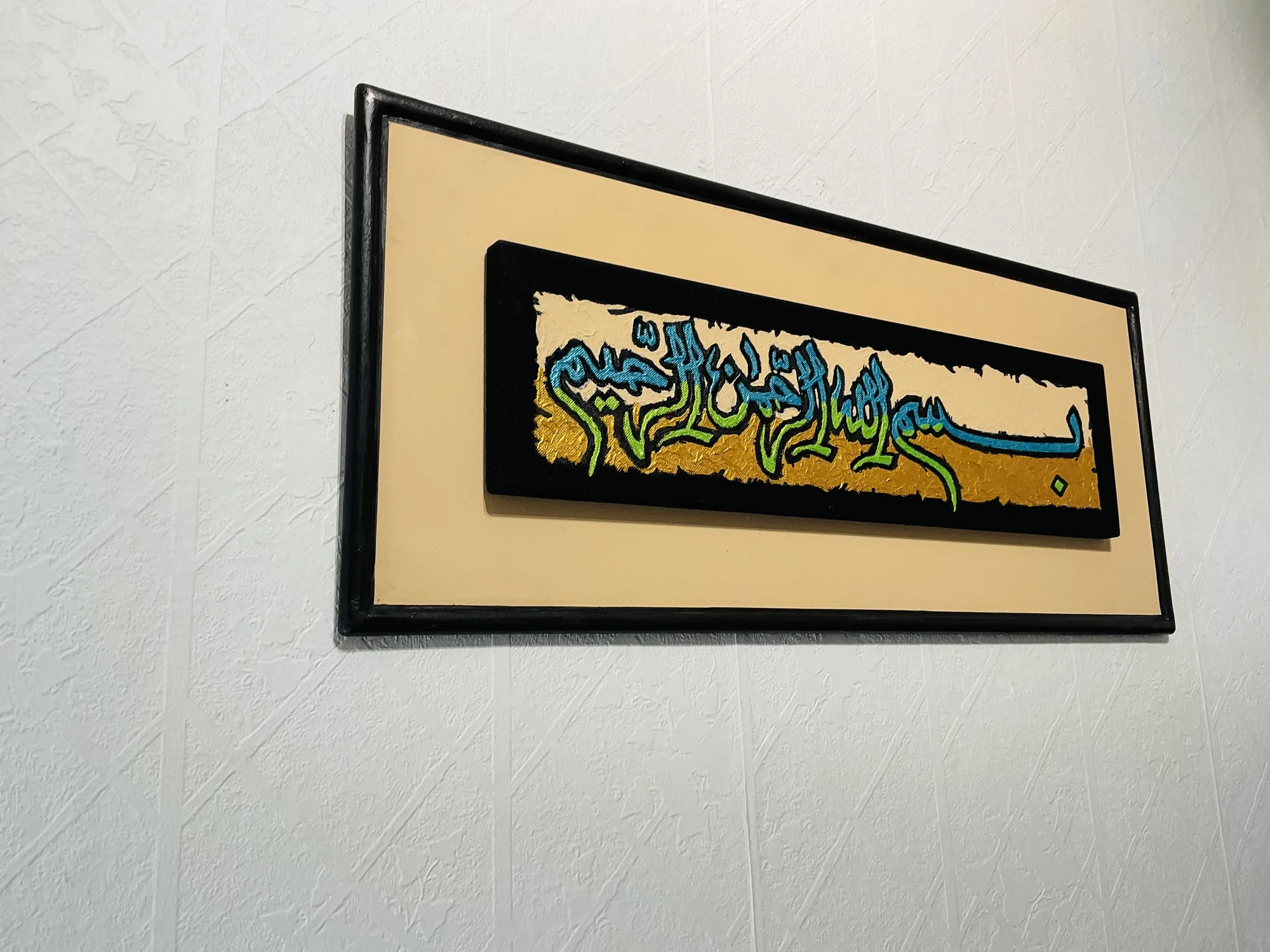
Maghribi calligraphy is the style of Arabic script that developed in North Africa and al-Andalus, recognisable by its sweeping curves that fall below the writing line and by a stroke of almost even thickness. Encyclopaedia Britannica lists it as a distinct branch of Arabic writing, set apart from the Eastern hands such as naskh and thuluth. It is the calligraphy of Morocco, Algeria, Tunisia, Mauritania and West Africa, and it held on to forms that the rest of the Muslim world slowly let go.
Put simply: while Baghdad and Istanbul wrote one way, the western edge of the Muslim world invented another, and kept it.
A script born between Kairouan and Córdoba
The story of the Maghrebi script begins around the ninth century, in two centres joined by the Mediterranean. In the east, Kairouan, in present-day Tunisia, was a major seat of learning and one of the busiest Qur'an copying workshops in the Muslim world. In the west, in al-Andalus, Córdoba and then Seville became capitals of the book, with libraries counting their volumes in the tens of thousands. Between the two shores ran a single root: Kufic, the angular script of Islam's first centuries.
Maghrebi copyists softened that Kufic across generations. Angles bent into arcs, letters rounded, the hand gained speed without losing legibility. By the eleventh century, under the Almoravids and then the Almohads, the style was mature and recognisable. When the Reconquista took the great cities of al-Andalus in the thirteenth century, Andalusi scholars crossed the sea and settled in Fez, Tlemcen and Tunis. They carried their hand with them. Andalusi and Maghrebi writing then merged into a single tradition, the one we now call maghribi.
How to recognise the Maghribi hand at a glance
A trained eye reads north african arabic calligraphy from a few precise signs:
- Curves that drop below the line. Letters such as nūn, ṣād and qāf open into wide semicircles that fall well beneath the baseline. This is the signature of the style, its most visible gesture.
- An almost uniform stroke. Where the East cuts its reed pen on a broad slant to play thick against thin, the Maghreb uses a finer point. The result is an even, supple, continuous line.
- Diacritical dots placed differently. A detail few people know: in Maghribi, the letter fā' takes a dot below and qāf a single dot above. In the East it is the reverse, fā' with one dot above and qāf with two. The same word is pointed differently depending on the region.
- Coloured vowels. Old Maghrebi Qur'ans kept, for centuries, a system of red, yellow and green vocalisation dots inherited from the earliest days of Islam and abandoned elsewhere.
Together these traits give the Maghrebi hand a rounder, more organic character, less geometric than the Eastern scripts. It looks written in a single breath.
A family of styles, not one
We speak of "the" Maghribi script, but it is really a family. Copyists distinguished several hands, chosen by purpose:
- mabsout (مبسوط), broad and steady, reserved for copying the Qur'an;
- moujawher (مجوهر), "the jewel", more cursive and quick, for correspondence and trade;
- maghribi thuluth, monumental, for titles, frontispieces and wall inscriptions;
- zimami (زمامي), steeply slanted and linked, used by notaries and in Sufi lodges;
- regional variants: the fine, tight andalusi, the fassi of Fez, and the heavier sudani of West Africa, which filled the great libraries of Timbuktu.
A calligrapher who commands maghribi does not know one script, but a whole keyboard.
The qalam, the tool that changes everything
Much of the difference between East and West comes down to a reed. The Maghrebi qalam is cut to a finer point than the broad Eastern nib. That cut, together with hand-prepared ink and a support of parchment and later paper, produces the continuous stroke that never thickens or thins abruptly. The letter flows. It is a patient gesture, where the pressure of the hand and the angle of the reed matter as much as the drawing itself.
Why Maghribi calligraphy stayed rare
Here is the surprising part. In the tenth century, in Baghdad, the vizier and calligrapher Ibn Muqla set rules of proportion for Arabic writing. Ibn al-Bawwab and then Yaqut al-Musta'simi refined the system into the six classical scripts: naskh, thuluth, muhaqqaq, rayhani, tawqi' and riqa'. This reform spread across almost the entire Muslim world.
Almost: it never truly reached the Maghreb or al-Andalus, too far west and already served by their own school. The Maghrebi script kept its own course, holding older forms closer to the original Kufic. That is what makes it so singular today. It was never smoothed by the Eastern canon. It is also why it is seen less often, since the grand narrative of Arabic calligraphy was written in Baghdad, Cairo and Istanbul, not in Fez or Kairouan.
In 2021 UNESCO inscribed Arabic calligraphy on the Representative List of the Intangible Cultural Heritage of Humanity, proposed by sixteen countries including Morocco, Algeria, Tunisia and Mauritania. A recognition that returns the western hand to its rightful place on the map.
The western hand, in the studio
I work this tradition with the qalam, a reed cut by hand and ink prepared with care. Born in Oran, moving between France and the Maghreb, I bring the Maghribi hand out of the manuscript and onto surfaces that let it breathe. Gold-leaf canvases, where the letter catches light the way it did in old Qur'ans. Wall frescoes that give an entire room the presence of a frontispiece. And bespoke calligraphy: a name, a verse, a line that matters, drawn in the hand of a chosen region.
To practise Maghribi calligraphy now is not to copy the past. It is to hold a thread a thousand years old and find it a place, on a hotel wall, in a majlis, on a canvas. The letter has not changed since Córdoba. What it says changes with the person who receives it.
A script from the west, that kept its own voice.
Frequently asked questions
- What is the difference between Maghribi calligraphy and Eastern Arabic scripts?
- The East codified six proportioned scripts (naskh, thuluth, muhaqqaq, rayhani, tawqi', riqa') from Ibn Muqla's tenth-century reform. The Maghreb stayed outside that canon and kept a hand of its own: curves that fall below the line, a stroke of almost even thickness, and different pointing, with fā' dotted below and qāf marked by a single dot above.
- Which countries use the Maghrebi script?
- It is shared across the whole Maghreb, the former al-Andalus and West Africa. Local variants exist: andalusi, the fassi of Fez, and the sudani of Timbuktu. It is one script family with regional accents, rather than the writing of a single country.
- What tools are used for Maghribi calligraphy?
- The qalam, a hand-cut reed pen. The Maghrebi version is trimmed to a finer point than the broad Eastern nib, which is why the stroke stays continuous and even, without strong contrast between thick and thin. Hand-prepared ink and a parchment or paper support complete the gesture.
- Why is Maghribi calligraphy so rare?
- Because the official history of Arabic calligraphy was written in Baghdad, Cairo and Istanbul, around the Eastern canon. The Maghreb and al-Andalus developed their writing in parallel, without that reform, so the style stayed rarer and less circulated, even though it preserves some of the oldest forms.
- Can I commission a Maghribi calligraphy artwork?
- Yes. At the Dari d'Art studio, Souad Bensaïd creates bespoke pieces in this style: gold-leaf canvases, wall frescoes and personalised calligraphy, a name, a verse or a meaningful line, drawn in the hand of a chosen region of the Maghreb.